🇺🇸

Car News from USA

A market built around pickups and SUVs, assembled increasingly in the South, and badged American whoever happens to own it.

82 articles · 18 brands

This page collects news about the American car industry: model launches, plants, regulation and ownership. The best-selling vehicle in the country has been a pickup every year since 1981, and nearly always the same one, the Ford F-Series. Light trucks, meaning pickups, SUVs and vans in the regulatory sense, take about four fifths of new sales, and the lineups have narrowed to match: several makers stopped building sedans for the market altogether. The United States assembles roughly 10 million light vehicles a year, and Michigan is no longer where most of that happens. Assembly moved south from the 1980s onwards, to states with lower labour costs and free land, and the plants there are not mainly Detroit’s. BMW’s site at Spartanburg, South Carolina is the largest vehicle exporter by value in the country. Since 2021 the additions have been cell plants rather than assembly lines, in Tennessee, Kentucky, Georgia and Ohio, most of them joint ventures between an American carmaker and a Korean battery supplier.

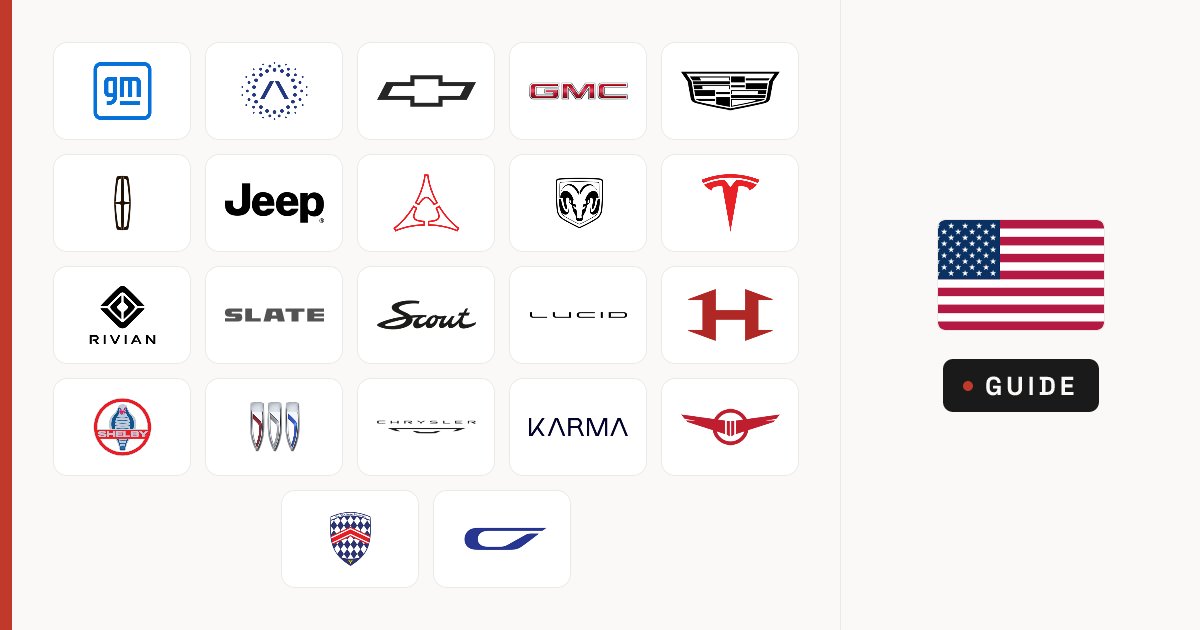
Ownership rarely follows the badge. Ford, still partly controlled by its founding family, and GM, which runs Chevrolet, GMC, Buick and Cadillac, are the American-owned half of the old trio; Jeep, Ram, Dodge and Chrysler are held by Stellantis from the Netherlands. The clearly American-owned newcomers are electric ones: Tesla, the truck and SUV maker Rivian, and the budget pickup startup Slate. The traffic goes the other way as well, with Scout, a 1960s nameplate revived for 2026, building in South Carolina for Volkswagen Group, and Lucid building in Arizona with Saudi Arabia’s Public Investment Fund holding roughly 57% of the company. Who owns what is set out in America’s car brands, explained.

Brands

View all 18 brands →

Factories

Market Data

Explainers

Korean car brands: six badges, four owners

Six car badges are built in South Korea and four companies own them. Hyundai Motor Group makes 84% of them, and two of the others are foreign-controlled.

China's car brands: who owns what

China's car market runs on a handful of giant groups, each fielding a stack of brands. Here is who owns what - the parent companies, the sub-brands, the Huawei alliance, and why the chart keeps changing.

Hybrid, MHEV, PHEV, EREV, EV: what each powertrain actually does

Six powertrains are on sale and three of them are called hybrids. What MHEV, HEV, PHEV, EREV and EV mean, how far each goes on its battery, and how to tell them apart.

How Norway made almost every new car electric

Norway sells almost nothing but electric cars, and never paid a purchase subsidy to get there. The tax structure that did it, year by year, and how it ends in 2028.

Joint-venture car brands in China

The Volkswagens sold in China are built by two companies, and one of them is Chinese. That arrangement started in 1983 as a condition of entry, and it has since produced badges that exist nowhere else: Jetta, Wuling, and AUDI in block capitals with no rings. Who holds which half, which brands the ventures invented for themselves, and which of the old partnerships have quietly ended.

America's car brands: explained

America's car industry comes down to a few big names, and not all of the 'Big Three' are American-owned. Here is who owns what: GM, Ford, the Europe-based Stellantis behind Jeep and Ram, Tesla and the EV newcomers, and the familiar names that are now owned abroad.

Japan's car brands: the alliance map

Japan's carmakers stay overwhelmingly Japanese-controlled, but the ownership lines are still tangled - Toyota holds minority stakes in three of its own rivals, and Nissan, Mitsubishi and Renault are locked into a 25-year cross-shareholding pact that a 2025 Honda-Nissan merger attempt failed to simplify.

Frequently asked questions
Who are the Big Three American automakers?
General Motors, Ford and Chrysler, a phrase that dates from the decades when those three built almost every car sold in the United States. It survives out of habit rather than accuracy: Chrysler has been foreign-owned since 2014 and is now one badge inside Stellantis. Detroit Three is the more common term today.
Are Jeep and Dodge American companies?
American by heritage and largely American-built, but not American-owned. Both belong to Stellantis, formed in 2021 when Fiat Chrysler merged with France's PSA Group, and the parent is registered in the Netherlands. Its largest shareholders are Italy's Agnelli family through Exor, and France's Peugeot family and government.
Why are pickup trucks so popular in the United States?
Two policies did much of the work. A 25% tariff on imported light trucks, in force since 1964 and known as the chicken tax, kept foreign competition thin for decades and left the segment to domestic makers. Federal fuel-economy rules then set easier targets for light trucks than for cars, and tie those targets to a vehicle's footprint, so a larger truck faces a softer standard than a small one.
Do foreign carmakers build cars in the United States?
Extensively. Toyota has assembled in Georgetown, Kentucky since 1988, Honda in Marysville, Ohio since 1982, and Hyundai in Montgomery, Alabama since 2005. Several models sold as imports are built domestically, and several wearing American badges are not.
Search