🇩🇪

Car News from Germany

Three groups - Volkswagen, BMW and Mercedes-Benz - cover almost all of German car production, and their brands reach well beyond Germany.

55 articles · 8 brands

This page collects news about the German car industry: model launches, plants, suppliers and ownership. Germany builds around 4 million cars a year and exports roughly three quarters of them, so the domestic market is a poor guide to what the factories actually do. The output skews expensive, and it stays put: the 911 has come out of Zuffenhausen since 1963, the S-Class out of Sindelfingen, and Wolfsburg is still the largest car plant in the world on one site. Volume SUVs are the exception, built where they sell. Underneath the badges is the other half of the industry, and the more widely sold one. Bosch is the largest automotive supplier anywhere, with ZF, Continental, Schaeffler and Mahle in the same tier, selling steering, braking and driveline hardware to carmakers on every continent; about 770,000 people work in the sector directly. Development habits are equally settled. A lap time at the Nürburgring Nordschleife is still quoted as a specification, by German and foreign manufacturers alike.

Three head offices account for almost all of the manufacturing. Volkswagen Group in Wolfsburg is the largest carmaker in Europe, with Audi, Porsche, Škoda, SEAT, Cupra, Lamborghini and Bentley beneath it. BMW Group in Munich owns two British marques, Mini and Rolls-Royce, both out of the 1990s break-up of the Rover Group, and took the tuner Alpina fully in-house in 2022. Mercedes-Benz Group in Stuttgart is the most concentrated of the three: one core brand, AMG as the performance arm, Maybach above them. Two German names sit outside that structure, Opel, which has answered to Stellantis in the Netherlands since PSA bought it from General Motors in 2017, and smart, a 50/50 joint venture with China’s Geely since 2019 with the cars built in China. The rest of the continent is mapped in Europe’s car brands.

Brands

Factories

Explainers

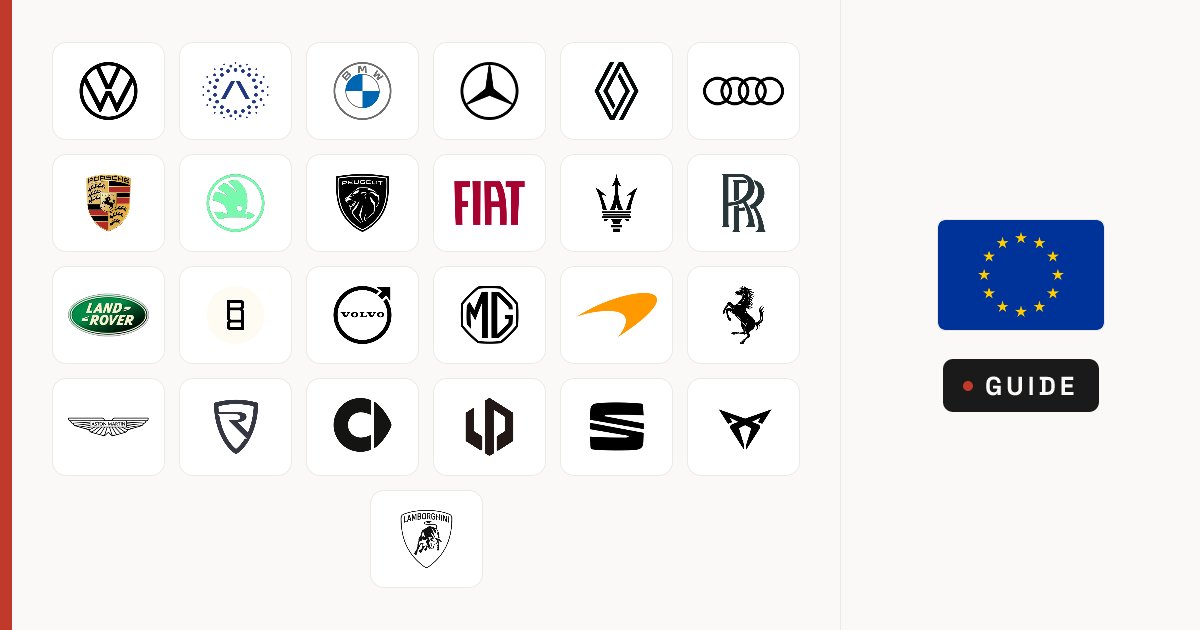
Europe's car brands: the ownership structure

Who owns Europe's car brands: the five groups that hold most of them, the icons now controlled from China, India and Abu Dhabi, and the same map sorted by country.

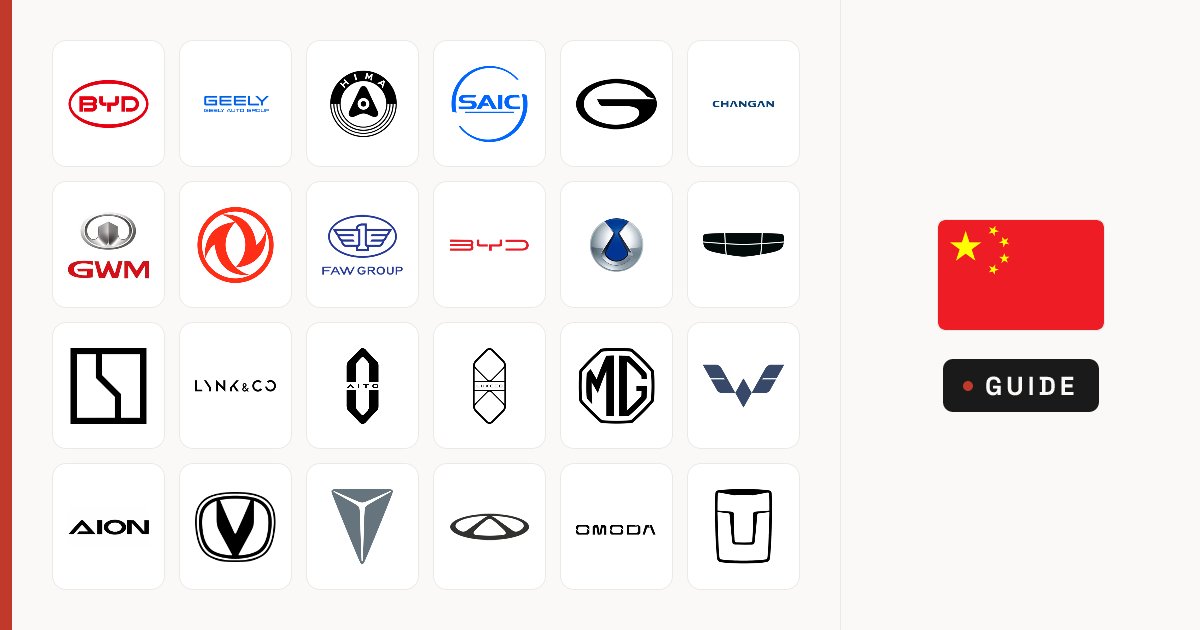
China's car brands: who owns what

China's car market runs on a handful of giant groups, each fielding a stack of brands. Here is who owns what - the parent companies, the sub-brands, the Huawei alliance, and why the chart keeps changing.

Hybrid, MHEV, PHEV, EREV, EV: what each powertrain actually does

Six powertrains are on sale and three of them are called hybrids. What MHEV, HEV, PHEV, EREV and EV mean, how far each goes on its battery, and how to tell them apart.

How Norway made almost every new car electric

Norway sells almost nothing but electric cars, and never paid a purchase subsidy to get there. The tax structure that did it, year by year, and how it ends in 2028.

Joint-venture car brands in China

The Volkswagens sold in China are built by two companies, and one of them is Chinese. That arrangement started in 1983 as a condition of entry, and it has since produced badges that exist nowhere else: Jetta, Wuling, and AUDI in block capitals with no rings. Who holds which half, which brands the ventures invented for themselves, and which of the old partnerships have quietly ended.

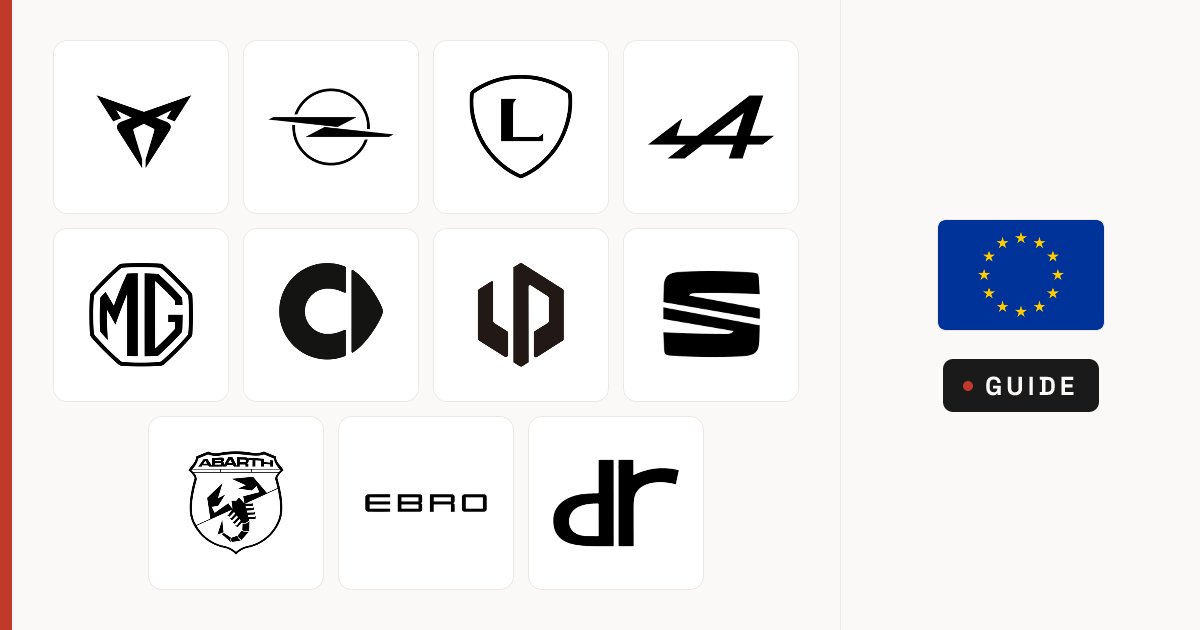
European car brands where the badge and the owner disagree

Twelve European badges whose nationality does not match their ownership: Cupra, Vauxhall, DS, Opel, Lancia, Alpine, Abarth, MG, Ebro, DR Automobiles, smart and Leapmotor. Some are Spanish or British names owned in Germany or the Netherlands, some are revived badges on Chinese hardware, and several are assembled in a third country again.

Frequently asked questions
Which car brands are German-owned?
Volkswagen, Audi, Porsche, Škoda, SEAT, Cupra, Lamborghini and Bentley belong to Volkswagen Group. BMW, Mini, Rolls-Royce and Alpina belong to BMW Group. Mercedes-Benz, Mercedes-AMG and Maybach belong to Mercedes-Benz Group. Opel is German-founded and German-built, but its parent is Stellantis in the Netherlands.
Is Porsche part of Volkswagen Group?
Yes. Porsche AG was floated on the stock market in September 2022, but Volkswagen Group kept the majority of its ordinary shares and it remains a group brand. A separate company with a similar name, Porsche SE, is the family holding vehicle that controls Volkswagen Group itself, which is where most of the confusion comes from.
What is the difference between Mercedes-Benz and Mercedes-AMG?
AMG is the performance division of Mercedes-Benz. It started as an independent tuner in 1967 and was bought by Daimler in stages from 1999. Its cars are Mercedes models with reworked engines, suspension, brakes and bodywork, sold through the same dealers, and the most powerful engines are still assembled at Affalterbach.
Are German cars built in Germany?
Many are not. BMW's largest plant worldwide is in Spartanburg, South Carolina, Mercedes-Benz builds SUVs in Tuscaloosa, Alabama, and Volkswagen Group assembles across Spain, Czechia, Slovakia, Mexico and China. Premium sedans and sports cars stay concentrated in Germany, while volume SUVs are built where they sell.

News about Germany

Hyundai opens European orders for the nine-seat Staria Electric

Hyundai has opened European orders for the Staria Electric, its first fully electric van-based MPV, priced in Germany from EUR 57,450. The Trend and Prime trims seat nine; only the range-topping Calligraphy drops to seven.

BMW iX5 Hydrogen enters series production in 2028

BMW has shown the new iX5 Hydrogen undisguised as it finishes its testing programme. Third-generation fuel cells developed with Toyota sit 25% more compactly than before, seven 700-bar tanks hold at least 7 kg of hydrogen, and BMW quotes up to 750 km of WLTP range on prototypes with a refuel of under five minutes. Series production starts in 2028.

Mercedes-AMG CLE 646 replaces the six with a V8

AMG has built 30 examples of the CLE 646 Spezialanfertigung, a Mythos-series coupe assembled by hand in Affalterbach. A flat-plane-crank 4.0-litre twin turbo V8 replaces the CLE 53's straight six, driving the rear wheels through a nine-speed automatic, and carbon fibre plus deleted rear seats take about 170 kg out of the car. All 30 are sold.

Volvo gives the XC40, EX40 and EC40 their first facelift in nine years

Volvo has restyled the XC40, EX40 and EC40 together for the first time since the XC40 debuted in 2017, with new Matrix LED "Thor's hammer" headlights, a redesigned front end, an 11.2-inch infotainment system with Google's Gemini assistant, and new safety hardware. Powertrains carry over: the mild-hybrid XC40 stays at 163 or 197 hp, the electric EX40 and EC40 at up to 436 hp. German pricing starts at €43,990 for the XC40.

Audi A2 e-tron revealed: four versions, 646 km

Audi has published the full specification of its entry-level electric hatchback: four rear-wheel-drive versions from 125 to 240 kW, batteries of 52, 61 and 84 kWh, up to 646 km WLTP and German prices from €38,200 to €51,200 (about $41,600 to $55,800). Orders open on 10 September, deliveries start in December.

VW ID. Polo orders outrun Martorell capacity

Volkswagen has confirmed more than 30,000 European orders for the ID. Polo, with dealers quoting a minimum ten-month wait on individually configured cars - order now and delivery falls in May-June 2027. The company points to demand and to planned capacity at its Martorell plant. Sibling MEB+ models show the same pattern: Skoda has over 35,000 orders for the Epiq, and the Cupra Raval is booked out for months.

VW approves Future Plan 2030, SEAT left open

Volkswagen Group's supervisory board has signed off Future Plan 2030, which cuts the model range by up to 50% and configuration options by up to 75%, and sizes the production system for around 9 million cars a year. SEAT says no final decision has been taken on its future.

BMW's next X7 keeps the V8 and gains an iX7

A second-generation BMW X7 has been filmed testing at the Nurburgring with four exhaust tips, which points to a V8 surviving into the new car. The bigger change is the electric iX7 that joins it, reported to run next-generation Neue Klasse batteries and motors on the existing CLAR architecture rather than on a dedicated electric platform.

AUDI's China-only EVs are on sale in Germany

An independent importer is buying AUDI E5 Sportbacks and E7Xs in China, shipping them to Germany and homologating them there. The E5 lists at €59,980 (about $70,200) against a Chinese guide price of ¥235,900 ($34,900), and the cars carry no factory support in Europe.

BMW is not putting the buttons back

Mercedes-Benz, Volkswagen and Hyundai have all restored physical controls after customer complaints. BMW Group Australia chief Vikram Pawah says the company reads the same evidence differently, and the new iX3 carries no climate switches on its dashboard at all.

Volkswagen may build its China EVs in Europe

Volkswagen is running a feasibility study into selling models developed by its Chinese operations in Europe, and building them at underused European plants rather than importing them. Zwickau has been named as a possible site. Six candidate models have been reported, none of them confirmed.

BMW i3 Touring spied at the Nurburgring

BMW has run a prototype of the i3 Touring at the Nurburgring, confirming an all-electric wagon for the Neue Klasse i3 family. The test car is believed to carry i3 50 xDrive running gear: dual-motor all-wheel drive, a 108.7 kWh battery and 400 kW DC charging. It is built alongside the sedan in Munich, with sales due in 2027.

Audi A2 e-tron: 646 km and €38,200 to start

Audi has posted the first hard numbers for its entry-level electric compact: four power levels from 125 kW to 240 kW, up to 646 km WLTP and a German list price from €38,200 (about $41,600). Production starts in Ingolstadt this autumn.

Mercedes C-Class gains power and real buttons

Mercedes has updated the combustion C-Class saloon and estate for Euro 7, moving every petrol and diesel badge up a step in output, dropping the 1.5-litre engine and the diesel plug-in hybrid, and replacing some of the steering wheel's touch pads with physical rockers and rollers. Orders open in Germany on 18 August 2026 from €48,844 (about $53,700).

BMW starts i3 production, Munich goes EV-only

Series production of the electric BMW i3 has begun at the Munich plant, the second Neue Klasse model after the iX3. BMW spent about 650 million euros (roughly $760 million) converting the site, which stops building combustion cars in 2027. The launch version is the i3 50 xDrive: 463 hp, 108.7 kWh, and up to 906 km WLTP.

The AMG GT 53 hits 503 miles by switching off a motor

Mercedes-AMG revealed the GT 53 4-door, the long-range entry to its electric GT family. Two motors make 536 hp, and the 106 kWh pack claims up to 503 miles (809 km) WLTP - achieved by mechanically decoupling the front motor under light load. From EUR 115,430. Figures are preliminary, not yet homologated.

Audi confirms a second-generation Q8

Brand CEO Gernot Döllner says the next Q8 had not been signed off when he took the job and the decision was reversed. The five-seat coupe format stays, with V6 and V8 petrol engines expected, including the 4.0 twin-turbo V8 from the new SQ9. No prototypes have been seen and the debut is expected around 2028.

BMW runs Spider-Man ads on owners' screens

BMW has pushed a full-screen promo for Sony's Spider-Man: Brand New Day to the infotainment systems of cars already sold, three years after saying it would not sell screen space for advertising. The campaign runs 27 July to 10 August 2026 in more than 70 countries.

Mercedes brings back physical buttons

Mercedes-Benz has started returning physical controls to its interiors after customer complaints about touch surfaces. The new CLA Shooting Brake and electric GLC get a steering wheel with rollers, keys and switches, and that wheel becomes standard on future models.

BMW plans more than 40 new and updated models through 2027

BMW is preparing its biggest lineup overhaul in years, with more than 40 launches promised across every segment as Neue Klasse design and technology spread from electric models to petrol, diesel, and hybrid cars. The electric iX3 and i3, an updated 7 Series, and the new X5 and iX5 are already underway, with a first electric M model and a BMW Alpina due in 2027.

Search